Who Did Brett Favre Play Agains the Day After His Dad Died
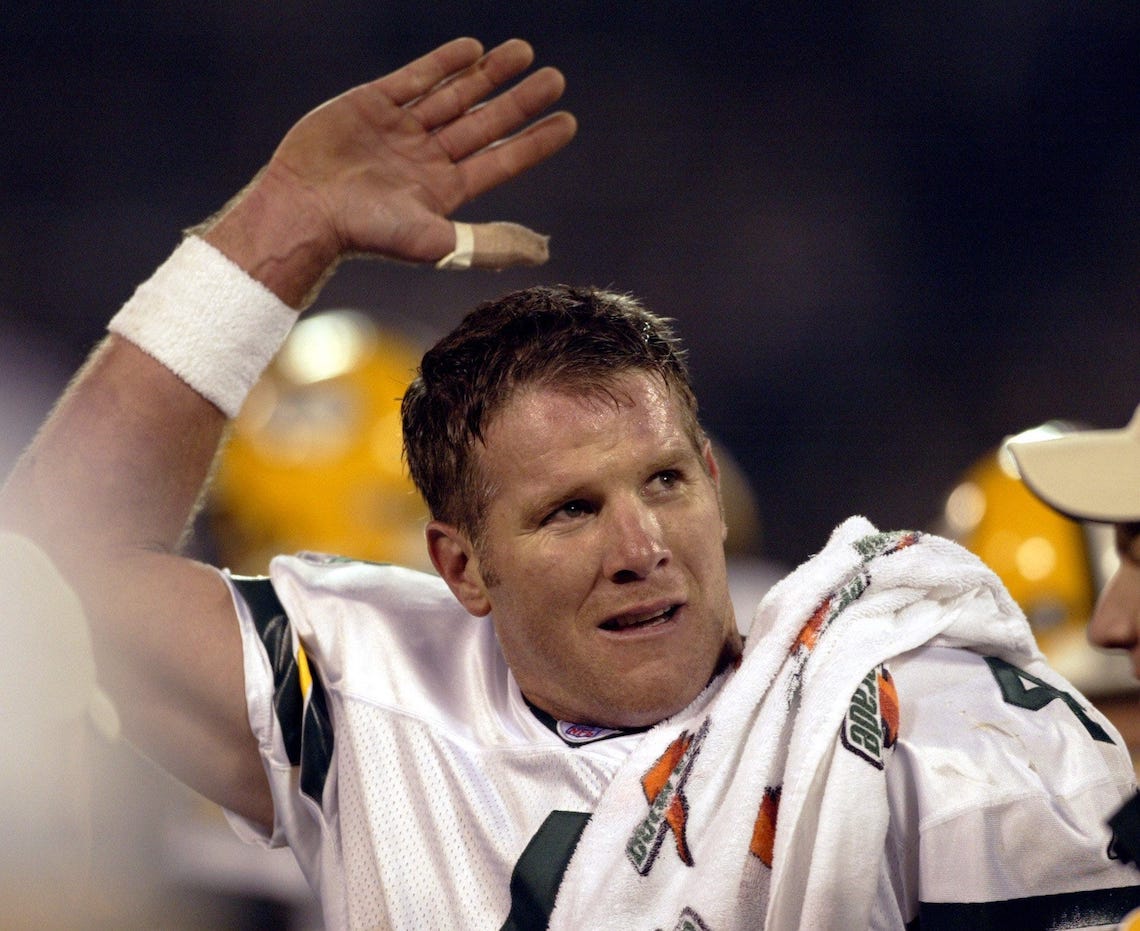
Tom Lynn, Milwaukee Journal Sentinel via USA TODAY Sports
Brett Favre's place in football history had already been established in December 2003. By so, he had go an unexpected college football game star and gone on to play in the NFL for over a decade.
He had a streak of consecutive starts for the Green Bay Packers stretching over 200 games, and had helped lead his team to a Super Bowl win.
When his male parent died all of a sudden but days earlier Christmas in 2003, some idea Favre's football game stats would suffer. Many assumed he'd need fourth dimension off to grieve.
Merely Favre turned tragedy into triumph.
Just one day after his dear father's abrupt passing, Favre took to the field and delivered ane of the best performances in his historic career.
In the midst of devastation, Favre honored his father the best mode he knew how—by playing football.
Growing up a Favre
Upbringing
Brett Lorenzo Favre was built-in to Bonita and Irvin Favre in the prime of football game flavor: October x, 1969. Irv and Bonita were school teachers in Gulfport, Mississippi, where Favre and his three brothers grew upwardly hunting and fishing.
Their primary pastimes, however, were playing football game and baseball game. In fact, their lives revolved around playing those sports.
The Favre family lived in a rural area , so in that location weren't many other children nearby. This wasn't a neighborhood of pickup brawl games or walking over to a friend'due south firm.
As a result, the Favre boys by and large played with one some other, often engaging in their favorite sports and other rough-and-tumble activities. That helped to form a tight knit, admitting competitive, family bond.
The Favres and sports
Initially, Favre excelled more in baseball than in football. The loftier school squad recruited him in the eighth form to play for the varsity team, where he lettered five years. Although he led his team in striking throughout his high school career, his arm took center stage. His older brother Scott considered him the second all-time on the team—when he was in 8th grade.
As he connected to grow, his peak and shoulders prepared him for success in football game as well.
Irv Favre coached his sons in football equally the caput coach of the varsity team at the local high school, Hancock North Central High. Irv pushed Brett, like his other sons, into the quarterback position, for which he caught serious flack.
His reasoning stood with his belief in his sons; he knew they would ever show upwardly to practice and put in the work. That was the expectation in the Favre house: You lot pull your weight, in sports and otherwise.
When Favre was not receiving snaps under eye, he excelled as a potent prophylactic or inside linebacker. Favre was known for his physicality and athleticism as well every bit the toughness he inherited from his begetter. Notwithstanding, his father pushed him into quarterback to provide consistency for the squad.
The quarterback position at Hancock was not a coveted one, though. Irv'due south crime leaned heavily on the run game, and scouts never saw Favre's arm. After returning from a football coaching clinic held by Alabama coaching legend, Paul "Behave" Bryant, Irv exclusively ran the ball, merely throwing it when his law-breaking needed to.
And fifty-fifty if scouts did see one of Favre'southward few passes in a game, they may non have been very impressed with his accuracy. Those around him, including older brother Scott, always viewed Brett as a better baseball game player than quarterback; Scott was the meliorate QB in the family unit.
Rocky Gaudin, who coached him from an early historic period through loftier schoolhouse aslope Irv, plant that Brett struggled when it came to accuracy . Fifty-fifty with the team's limited number of passes, his performance could be unpredictable.
His leadership skills, work ethic and competitiveness, on the other hand, were unmatched. To Rocky Gaudin, it set him apart. Irv believed so too, though he never told his son this.
One day later a bad game, Favre overheard the coaching staff talking, expressing skepticism in him equally the starting quarterback. Irv argued that he believed his son would bounce back and redeem himself, considering that was foundational to Brett'due south identity.
His father never really shared emotion nor told his kids he was proud. He just pushed them to meliorate, expecting naught brusque of perfection.
And considering of this, Favre pushed himself to be better—always.
College recruitment
During his junior and senior years of loftier schoolhouse, Favre strived for a scholarship to play college football. Irv'southward playstyle, however, did not exactly mesh with that goal considering the Hancock North Fundamental Hawks simply threw the ball effectually five times a game.
Nonetheless, Irv pushed his alma mater, the University of Southern Mississippi (where he had starred in baseball), to take a look at his son. Subsequently a couple of games and fewer than 15 pass attempts observed, USM told Irv a quarterback scholarship was non possible for Favre.
They did offering Favre a scholarship for defensive back, which Favre rapidly accepted. Information technology was his only scholarship offer.
College years
From the bench to the starting spot
Favre's college years started off rocky.
Ranked seventh in the quarterback depth nautical chart, Favre fought an uphill battle. He received no playing time in the season opener against Alabama and expected to be redshirted . His roommate, Chris Ryals, felt the same .
The night before the game against Tulane, Favre and Ryals stayed up late drinking and sharing woes of non receiving any playing time in the game they loved. Together, they finished off 36 beers.
The following morn, both students felt hungover, with a young Favre throwing upwards on the sidelines. Favre might have felt miserable, just the coaches believed in his ability to perform and burned his redshirt.
Early in the third quarter, Coach Jim Carmody switched a young and ill Favre into the game. The crowd, recognizing Favre, roared for the local phenomenon to the bewilderment of older teammates. They had seen him throw at practice, but confusion arose as to why this young, hungover kid was causing such an uproar.
It did not take long for all of his dad's training to come rushing back and for the confusion to dissipate.
He led the team to a come-from-behind victory to win 31-24 .
After that game, no ambiguity existed in who held the starting quarterback position: Favre was at the helm. From that bespeak forward, Favre led USM's Aureate Eagles to success.
Senior yr and connected success
After Favre took the reins in 1987, the football programme at USM encountered some personnel changes.
In the kickoff year later on transitioning from Coach Jim Carmody to Motorcoach Curley Hallman, the Gilded Eagles reached success, winning the Independence Bowl confronting the University of Texas at El Paso with a final record of x-2.
The yr after, however, finished with Favre and USM at v-6. Despite the losing season, he maintained like stats to the previous year, recording over 10 touchdowns and passing for over two,200 yards.
Favre aimed to ameliorate for his senior year, but weeks before returning to campus, he was injured in a serious machine accident. The damage required multiple surgeries and involved a bad concussion, cracked vertebrae and severe internal damage.
A calendar month later, Favre showcased the toughness his dad had instilled in him and upset Alabama in his beginning game back. The coaches considered redshirting Favre, allowing him to maintain a year of eligibility, just he immune no talk of it. He wanted to play.
Unfortunately, his season did not ultimately plow out as planned, as he just accounted for a portion of his previous season's milestones. However, the team performed well, achieving an 8-iii tape and losing by eight collective points over the regular season.
Though the team lost in the All-American Bowl to North Carolina State University, Favre however won the MVP laurels. Favre was and then given the honor to play in the senior basin, the East-West Shrine Game, in which he was awarded MVP honors equally well.
At the time, Irv and Bonita still stressed the importance of getting a degree . They didn't want Favre to place all his bets for the future in a possible athletic career.
Later on moving from defence to quarterback, recovering from a serious car blow, receiving MVP awards and setting multiple school records, Favre did equally his parents wanted and graduated with a degree in teaching, only like Irv and Bonita.
At the aforementioned time, however, Favre had managed to plough a defensive dorsum scholarship into a starring role as quarterback. Past topping school records and setting himself up to be drafted in the 1991 pro football game draft, he seized an opportunity and ran with information technology.
Turning pro
Atlanta Falcons
In the 1991 NFL Draft, the Atlanta Falcons selected Favre with the 33rd pick.
Favre started third on the depth nautical chart behind Chris Miller and Billy Joe Tolliver . On both of his starting time pass attempts, Favre threw 2 picks .
Reasonably, the Falcons front office and coaching staff were not enamored with him. Falcons coach Jerry Glanville vocalized his displeasure with Ken Herock drafting Favre in the second round by not playing him unless they had "two plane wrecks and iv quarterbacks go down."
Glanville later defended his treatment of Favre, alluding to the fact that Favre'south excessive drinking made it necessary to merchandise him from the team. With the newfound freedom and lack of oversight due to his position on the depth chart, Favre had been taking advantage of his time in a big metropolis.
The Falcons bundled for a trade at the offseason: a showtime-round pick for Favre. Ron Wolf, in his first year transitioning from the New York Jets, helped the Packers get away with a steal.
Starting off with the Green Bay Packers
For Favre, the Packers were an entirely different experience from his time with the Falcons.
Don Majkowski started the first two games, with Favre gaining the opportunity under center for the second one-half of a blowout loss to the Tampa Bay Buccaneers. His kickoff pass attempt was a completion—to himself. Over the course of the half, he threw for 75 yards and a choice.
During the third game of the season, a home game against the Cincinnati Bengals, Majkowski was injured with an ankle sprain, and Favre ran onto Lambeau Field in his place.
Favre fumbled iv times in that outing and was booed by the fans. He also threw 22 completions on 39 attempts for 289 yards and 2 touchdowns, including the game winner with 13 seconds left on the clock. His long last bulldoze to win the game with simply over a minute left solidified his spot in the starting lineup.
The Packer'due south 1992 season ended with a 9-7 record, barely losing out on a playoff berth due to its NFC North rivals the Minnesota Vikings. The next season, the Packers repeated its humble success, receiving a wild card birth and achieving a playoff win against the Detroit Lions. Over these two years, Favre threw for 37 interceptions to accompany his 37 touchdowns, but was still selected to the Pro Bowl.
Favre's toughness and belief in himself shone through his playstyle. He could take hits and still get up, set to start the side by side play. Team doctors would help him proceed moving; all he wanted to do was go along playing.
In 1994, Favre cleaned upward his passes and bolstered his accuracy, throwing for 33 touchdowns and 14 interceptions while the Packers once once again went nine-vii.
MVP seasons
Packers fans know the menses from 1995-1998 as the gold years for Favre. He led the squad to win its division three times in a row, culminating in ii Super Bowl appearances and one Super Basin ring. He was elected NFL MVP three times in a row, the outset and only to do so in NFL history.
In the midst of this success, Favre addressed his prescription pill addiction. In Feb 1996, less than a month later on leading the Packers to the NFC Title game, Favre voluntarily entered the league'south drug abuse recovery program. The year after his return from rehab, he led the Packers to their Super Bowl win.
Over these 3 seasons and despite his drug abuse challenges, he amassed 112 touchdowns, 12,179 passing yards, and only 42 interceptions, averaging over 37 touchdowns and merely 14 interceptions a season.
In response to his son'due south incredible cord of seasons, Irv wrote a touching article about his pride and belief in Favre. He expressed joy in being able to lookout his son succeed in the football globe.
Postal service-1997 Packers
The Packers' 1998 season concluded a streak of 6 playoff appearances. Coach Mike Holmgren, who started with the Packers the aforementioned year as Favre, moved on to the Seattle Seahawks.
In the years transitioning from ane coach to the next, the Packers fell from the level of success it previously experienced. The team did not return to the playoffs until the 2001 season and never made it past the divisional round.
At this point in Favre's career, he had already established himself as a Hall of Fame quarterback.
Leading into the 2003 season, he had accumulated 11 winning seasons in his 12 years every bit a starter. Favre was the epitome of toughness, making over 200 sequent starts, never sitting out a unmarried game for injury or affliction.
That streak came into question in late December 2003.
Irv's passing
On Sunday, December 21, 2003, Irvin Favre passed away from a heart attack while driving near Favre'due south hometown of Kiln, Mississippi.
Favre received a phone call from his wife Deanna while driving in San Francisco with teammate Doug Pederson. The Packers had already arrived in the Bay Area in preparation for their Monday nighttime football game game against the Oakland Raiders.
Deanna informed Favre of the news of his father'due south passing and flew out to be with him early on the next morn.
News rapidly spread within the Packers organization. Teammates opted not to speak about it out of respect for Favre, but tried to be in that location for him when he called on them.
Tight end Donald Driver spoke with Favre for near an hour. Kabeer Gbaja-Biamila, who had lost his female parent the year before, also helped Favre process the news through his own emotions going into the game.
Favre had a decision to make.
Would he continue his streak of consecutive starts, or would he accept time to grieve his father?
The decision to play
To face such a hard decision then quickly later on experiencing loss, the average person would have shut downward and backed out of the starting position. In fact, that would exist expected based on the wealth of psychological research on trauma and loss.
Favre, nevertheless, had some other idea.
He wrestled with the idea of whether to compete the next day, but just for a brusk time. Inside a thing of minutes, he felt strongly that the right thing to practise was to play.
Favre reflected on his father and his childhood, realizing that football united his family unit. He thought his begetter would have wanted him to play.
Favre told his teammates that he had no intention of leaving his football family that night. While one member of his biological family had passed, his football family surrounded and uplifted him, supporting him in his decision to play.
Favre'southward historic game
On December 22, 2003, Favre ran onto the field at Oakland Coliseum for his 205th sequent game. Normally, Favre would get in early to become extra throwing repetitions earlier each game, but on this occasion, he emerged from the locker room shortly before kickoff.
The unabridged stadium felt the electricity in the air and knew what this game meant to him and the Packers program. Beyond the emotional importance, the game also held playoff implications. The Packers had to win in lodge to take a chance to receive a playoff berth.
A commonly raucous Oakland oversupply instead cheered for Favre when he was introduced as a starter, holding signs showing their solidarity and sympathy.
John Madden and Al Michaels chosen the game for the Mon Night Football game broadcast. Before the game, the announcers discussed the uniquely difficult position Favre was in. They marveled at his conclusion to play and wondered how he'd handle the pressure.
Brett's performance
For a game in which it would be completely understandable to struggle on the field, Favre blew it out of the water.
In the get-go half alone, Favre threw for 311 yards and completed four touchdown passes.
His first 9 possessions he completed for 184 yards, connecting with Wesley Walls and Javon Walker for touchdowns. His 10th was an intentional pass out of play. His next iii attempts were all completed, including another touchdown pass to Walker.
Favre finished the second quarter with another touchdown, bringing the halftime score to 31-vii.
The referees recall that game as if the stars had somehow aligned for laissez passer after pass completion. It seemed every bit though the ball kept finding its way to the receivers—almost every laissez passer from Favre, regardless of coverage, was caught. To the referees of the game, information technology seemed like he could not brand a mistake.
Even the Raiders players did not play in their usually rowdy way. They pressured Favre, but their physicality resulted in minor penalties compared to their status quo.
Part of the reason for the exemplary performance could be the laidback defence. Perhaps another contributing cistron could exist the rest of the squad playing with a bit more than spark than usual. After all, teammate and friend Donald Driver had encouraged the receiving core to take hold of every ball thrown their way.
But Favre, afterward the game, thought it could be something else: "I know he was watching tonight."
"I knew my dad would have wanted me to play. I know he was watching."
1 day after his father'due south death, Brett Favre went on MNF and threw for 399 yards and four TDs 💚
(via @nflthrowback)film.twitter.com/aHK5Mdze6N
— Sports Illustrated (@SInow) June 21, 2020
One night after the decease of his begetter, Favre put on a operation for the ages. His terminal stat line read 22 completions on 30 pass attempts for 399 yards and four touchdowns, with a passer rating of 154.9.
Because of this game, Favre connected his streak for most consecutive starts while also bolstering his position in NFL history for touchdown passes.
Postgame emotions
After the game, Favre told reporters that he felt his dad would have wanted him to compete that night.
Football had been such a meaningful part of their human relationship, from the time his father encouraged him equally a child, to coaching him in high schoolhouse, to cheering him on in college and the NFL. The game was an integral office of their family unit'southward bond, so he played to honour his dad.
Favre and his wife Deanna embraced on the field and left to board a flying home to Mississippi. Others around him watched in awe and gratitude for the functioning—one that some might phone call the best of his career—later an event that all would call a horrible tragedy. His teammates , peculiarly, marveled at what he had just accomplished and felt inspired by his performance.
The influence of Irv Favre carried well past those he coached or spoke to. His toughness, character, perseverance, and legend lived on through his children, especially Brett. Favre passed on that success and honey for the game for which his dad felt pride.
Those at home felt a similar touch.
Future star and Wisconsin native J.J. Watt watched as a kid. He remembers what he referred to equally a "magical" performance by Favre and the Packers.
The NFL also felt it was magical, as they ranked this game every bit the 52nd best game of all time.
Life after Irv's passing
In the years after, tragedy continued to follow. Ten months later Irv passed, Brett'due south brother-in-law passed abroad after an ATV crash on the Favre'south belongings. Soon, doctors diagnosed his married woman Deanna with breast cancer. And later, friend and teammate Reggie White died all of a sudden.
With all of this hardship, Favre connected to perform well in the NFL, admitting not at the previous levels, and the Packers were not in playoff contention much in the years that followed. The direction drafted Aaron Rodgers in 2005 and traded Favre away soon subsequently.
However, afterward a brief stint with the New York Jets, Favre constitute success with the Minnesota Vikings for a few years before retiring at the age of 41 after his 20th flavor.
Before his passing, Irv had shared with Deanna how excited he was for Brett to be elected into the Hall of Fame. He told her he couldn't await to come across it, and the function he was most excited for was presenting his son.
Deanna shared this memory with Brett on the aeroplane on the way habitation from Irv'south memorial. From that point on, Brett wanted to get in happen to honor his late father.
In 2016, Favre was elected into the Hall of Fame on the outset ballot he was eligible.
At present, Favre honors his father's memory past coaching at a high schoolhouse in his town. Though their approaches might vary slightly, and the younger Favre may opt to throw the brawl more, the Favres' toughness, resilience ,and centre continues to be passed on through the younger Favre'due south team.
Though the Favre men did not discuss much or share many affirmations to one another, they did share the common language of sports.
By putting on the performance he did on December 22, 2003, Favre was able to award his father by playing football game, the game they both loved.
Sources:
- Raised On Grit: Favre Was Toughened By Brothers, Dad
- Life Of The Party: Favre Defenseless On Quickly In College
- Sports Reference: Brett Favre
- 1990 Southern Mississippi Gold Eagles Schedule And Results
- Reckless Rookie: Within Brett Favre's Strange Season With The Misfit Atlanta Falcons
- Glanville's Eye-Opening Explanation Of Trading Favre
- Cincinnati Bengals At Greenish Bay Packers – September 20th, 1992
- 1993 Green Bay Packers Statistics & Players
- Pro Football Reference: Brett Favre
- The Best NFL Game Brett Favre Ever Played
- Favre's First Half: four TDs, 311 Yards
- Brett Favre's Greatest Game – An Oral History
- Favre's MNF Dad Game – December. 22, 2003
- Green Bay Packers At Oakland Raiders – December 22nd, 2003
- Week 16 – Favre's Legendary MNF Game Afterwards His Dad Passed Away
Source: https://www.sportslingo.com/locker/brett-favres-historic-game-after-fathers-death/
0 Response to "Who Did Brett Favre Play Agains the Day After His Dad Died"
Post a Comment