New York Times Book Review Too Big to Fail
The Information Broker

For journalists, bad news can be good news. And so, in the wake of the Lehman Brothers plummet last September, as the world'due south economy teetered, an all-star roster of business journalists—Roger Lowenstein, Joe Nocera and Bethany McLean—raced to shop volume proposals to chronicle the epochal events unfolding on Wall Street and in Washington, D.C. On the morning of September 23, 2008, Andrew Ross Sorkin, the New York Times' and then-31-year-old star financial reporter, made the rounds to publishers with his agent and his proposal, which he'd pulled together over a weekend. "Information technology was like Paulson'southward original tarp proposal," Sorkin tells me, referring to the sometime Treasury secretary. "His was three pages, mine was three pages."
Nosotros're sitting at the Lyric Diner on 3rd Avenue on a Monday morning. Sorkin'south Tuesday Times column is due in a few hours, but, as usual, he's way backside, and afterward I learn that he missed it entirely and his editors had to scramble.
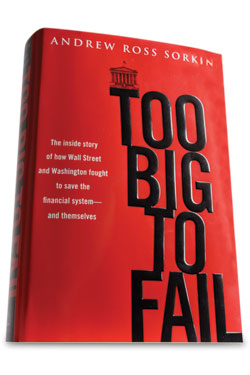
His excuse is that he's got a volume to promote. Also Big to Fail, for which Viking paid a reported $700,000 and which debuted at No. 4 on the Times' best-seller listing, is a nearly minute-past-minute account of the financial crisis as observed through the eyes of the clashing Wall Street CEOs who drove their investment banks into the abyss and the government regulators who watched powerless from the sidelines. The book has become a kind of media sensation. In a review for the Financial Times, John Gapper declared that Sorkin had written this generation's Barbarians at the Gate. Charlie Rose compared Sorkin to Bob Woodward. Vanity Fair published an excerpt and held a book party at Graydon Carter's Monkey Bar ("Part of the package we put together for him," Carter says). Three weeks agone, every bit the book landed in stores, Sorkin blanketed the airwaves, showtime with an October 19 advent on the Today evidence, followed by multiple stops on CNBC and his second appearance in a calendar month on Charlie Rose.
"I'm very surprised by the reaction," Sorkin explains, as we sit over bowls of oatmeal at a rear table. "Just information technology's good! I can't complain." Despite the highs of the past week, Sorkin looks exhausted. He's eschewed his usual Ted Baker suits—"Yous have to dress similar them," he says of his cast of sources—for jeans, a striped blue shirt, and a blazer. At a particularly loud moment in our interview, when he picks upward my digital recorder and holds it to his oral cavity, he looks like a CEO dictating notes to himself.
Sorkin, who started at the Times as an 18-year-erstwhile intern, and who founded and edits the Times' influential DealBook blog and writes a weekly front-folio business-section column under the DealBook flag, has cultivated an A-listing of Wall Street power players as his sources, a remarkable feat considering that many of these men are twice his age and he writes for a newspaper that has traditionally been a center-of-the-pack player in business journalism.
It's hard to overstate Sorkin'due south axis every bit an information hub on Wall Street these days. DealBook is a high-level Wall Street message board. By now, information technology's a cocky-reinforcing cycle: Everyone on Wall Street talks to Sorkin, which makes everyone demand to talk to Sorkin. "You lot never know when y'all demand to become back to the favor depository financial institution," one senior investment banker explained. "Why would a Hank Paulson or a Jamie Dimon or a John Mack pick upwardly the telephone and talk to him?" asks one head of communications for a financial institution covered by Sorkin. "They want to hear what anybody else is saying."
The book party for Too Big to Neglect was a window into Sorkin's globe. No one tends to love a journalist after a story is written, particularly one most a failure with equally many fathers equally the financial crisis. But Sorkin, remarkably, avoided this problem. Attendees—Sorkin's presumed unnamed sources—included Jamie Dimon, John Mack, Ken Griffin, Steve Rattner, and Barry Diller. Warren Buffett mailed in an Ed McMahon–size "colossal-gram" that read, "Andrew … Congratulations! Your book will be bigger than this telegram." "It showed how powerful he is," says Jeffrey Taufield, a partner at the Wall Street PR firm Kekst and Company. "What you noticed when yous went was how many powerful Wall Street people were in that location to osculation his band," adds The New Yorker's Ken Auletta, a party invitee. "He's a 32-year-old guy, and in that location were all these titans of Wall Street crowding around to say howdy and brand dainty to Andrew."
While Sorkin basks in Wall Street'southward attention, his image at the Times is more conflicted. His ascension at the paper was jet-propelled—he was a kind of legend before he was xx. And he was one of the beginning at the newspaper to realize the axis of the web and also one of the start to realize that on the web, a journalist's personal brand can sometimes be more valuable than that of the institution that employs him. With his DealBook electronic mail, read by some 200,000 people, plus the blog, with 2.v million unique monthly visitors, plus the weekly column, breaking news scoops, television appearances, and 60,000 Twitter followers, he is one of the Times' most visible players. Media ubiquity is a strategic decision. In the cubicle jungle of the Times, he'due south an entrepreneur. "All of information technology is self-reinforcing," Sorkin says.
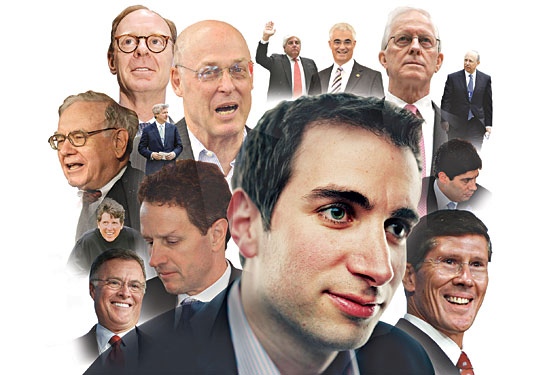
Yet, part of Sorkin's problem at the Times is that he's a new sort of creature at an essentially conservative institution, admitting one that badly needs new models. He's not a Timesman, exactly. He's his own creation, and he doesn't genuflect to Times traditions.
In these dark days for newspapers, Sorkin, with his un-Timesian public face, unorthodox methods, and precocious success, has become a flashpoint for some of his colleagues. At bottom, they see him as far as well cozy with his sources. In a profession that tends, with religious fervor, to draw bright lines and stay backside them, Sorkin seems to cantankerous back and forth without a care. While he has written critically about the financial mandarins he covers, a fawning quality tin can ooze into his prose that some other Timespeople find unbecoming. "Over at the power tabular array is Lloyd Blankfein of Goldman Sachs, or should I phone call you the human being who can practise no wrong?" (December 30, 2007) … "Trying to defend Stephen A. Schwarzman, Wall Street'south whipping male child of the moment, seems like a lose-lose proposition … Only hey, somebody has got to go to bat for Mr. Schwarzman. Might likewise be me" (July 29, 2007) … Or the second fourth dimension the discussion subprime appears in his column, two months before Bear Stearns blew up, when credit and real-estate markets had already begun their steep nosedive. "I know many of you aren't in a political party mood," Sorkin wrote. "Things were going great until summertime, when the subprime mortgage thing really took us down a notch—and ruined more than a few golf games."
(Detractors also mention stories Sorkin hasn't written. Earlier this yr, Sorkin was as well busy to write a critical series on private-disinterestedness companies like Cerberus and the Blackstone Grouping, firms he championed during the smash and virtually which he had deep knowledge. The editors had to observe other reporters to do it.)
Some of his antagonists in the newsroom wonder what, in the end, his privileged access is in the service of. "It's the Jon Stewart question," one senior Times staffer said, referencing Stewart's memorable takedown of CNBC's pre-meltdown boosterism. The squawking, which is loudest among the reporters on the business staff and not among higher-ups, has lately gotten louder, and meaner. As Sorkin's career has burgeoned, he'south developed another audience of close readers: his colleagues, who rummage the column for evidence of favor-trading. In conversations with me, several compared Sorkin'south relationship with the Wall Street elite to disgraced former Times reporter Judith Miller's alliance with Bush-administration officials peddling bogus intelligence in support of the Iraq War. "She got likewise close to her sources," a veteran Times staffer told me. "It was disastrously wrong and we let our readers downwardly. This is the financial equivalent of that." The analogy seems slightly strained. Just certainly, Sorkin's sources, the ones who have often been treated with kid gloves in his column, are the very actors in the executive suites who triggered the collapse, and closeness inevitably distorts reporting. Sorkin's critics at the Times say that this result weakened the newspaper's fiscal coverage during the bubble. But access is one of the places where scoops come up from—the career of legendary Times columnist James Reston, among many others, is testament to that. It'due south a complicated balance in whatever newsroom.
Sorkin has heard these charges of access journalism before, and he dismisses them. "I think to the extent I've been able to get inside the room, it's a office of hopefully coming to the table and being fair and open," he says, "merely also coming to the table and being sufficiently skeptical, but not cynical." He adds that many of his sources hate what he writes.
Ii weeks ago, these tensions spilled into public view in an commodity in the New York Post that reported that Sorkin had failed in his book to credit an Baronial 9 front-page article by veteran investigative reporters Don Van Natta Jr. and Gretchen Morgenson, a pair of journalists long known for their ambitious style. Morgenson is an especially fierce critic of Wall Street'southward excesses and frequently draws the ire of Sorkin's high-level cast. Van Natta and Morgenson, according to sources, suspected Sorkin of piggybacking on their reporting, perhaps after being tipped off by business editor Larry Ingrassia, who is a Sorkin champion, and following their tracks in order to obtain crucial details for his book. Executive editor Bill Keller and managing editor Jill Abramson moved to quell the dispute, but it still simmers. Keller is effusive in praise of Sorkin, while acknowledging some of the issues. "Andrew may seem like a new miracle," he wrote in an east-post, "only at eye he's a archetype beat reporter. He develops real inside sources, he works them relentlessly, and they tell him stuff because a) they regard him as essential reading, and b) he treats them fairly."
The sniping over Sorkin is partly petty within baseball, a matter of professional competition and jealousy of the kind that come with the morning coffee at the New York Times. But it's happening at a specially dire moment, ane that gives information technology added resonance. The Times just announced that it was cutting some other 100 newsroom jobs, and no i is completely certain which employees—or indeed, which journalistic values—volition survive the ongoing migration to the web. Sorkin has already created a profitable business with DealBook on the spider web. And he's a star, certainly—the brightest one the Times has produced in a while. Is he the announcer of the futurity? Some of his colleagues hope not.
To write about the game, you have to know the game. Sorkin has a deep and highly particularized cognition of the deal-making landscape, a pressurized beat populated by PR advisers, bankers, lawyers, where information translates into dollars and anybody has a fiscal stake in an outcome. Sorkin communicates with his sources as an equal. "Oftentimes when you talk to reporters you lot take the sense they don't understand what the deal is about. You don't have that problem with Andrew," says Jonathan Knee, a senior managing director at Evercore Partners, a boutique investment firm. There'due south likewise serious shoe leather at piece of work. He's often upward at vi a.m., working the phones, sometimes fielding 200 calls in a day. "I get such a high off the twenty-four hour period-to-solar day, moment-to-moment," Sorkin says. "I love being at that sort of nexus of knowing where the deal is and what'southward coming next and how it's going to work and the construction of the deal."
He'south open up most the fact that he's not adversarial. "I don't come up to the table with an ax to grind—that helps me," Sorkin says, sipping an iced coffee. He has another crucial advantage in the world he's traveling in: He gives good son. "There's something near his boyish, Jimmy Stewart charm that the older men he deals with find incredibly winning," Graydon Carter says.
"When did you lot get the Paulson waiver?" Van Natta asked. "Is this an inquisition?" Sorkin replied
In March 2006, when the Times launched the DealBook blog on the paper'south website, it vastly expanded Sorkin's footprint at the paper. The web log, one of the Times' most aggressive new-media ventures up to that indicate, featured commentary on breaking fiscal news. Sorkin now manages a staff of eight DealBook contributors. Three years ago, he was besides promoted to management, which meant he could exist paid far to a higher place the Times' strict union-mandated salary scale. Sources say he earns $250,000, including a bonus that is based, in part, on the fiscal performance of the diverse DealBook backdrop (Sorkin disputes the number, simply won't be more specific). He is amongst the highest-paid staffers at the newspaper.
In January 2008, Times business organization editor Larry Ingrassia promoted Sorkin's column from Sunday, where it appeared inside the department, to the forepart concern page on Tuesday. A former Wall Street Periodical editor, Ingrassia joined the Times in 2004 and is known inside the newspaper equally an editor who drives his staff hard to break news. In this style, Sorkin is an indispensable nugget on the hypercompetitive deal beat, where the Times used to lose more often than not. "If we hear something is happening, editors plow to themselves and say, 'Where'southward Andrew?' " Ingrassia tells me. "Information technology's amazing; he'll say, 'Let me make a couple of calls,' and inside 15 minutes, he'll observe out if at that place's a deal in the works. He's become a go-to guy helping us break stories."
Sorkin'south shift to Tuesday was certainly a promotion, but for Ingrassia, it's too a way to distance Sorkin from Lord's day business editor Tim O'Brien, a former investigative reporter who was ofttimes at odds with Sorkin and who, co-ordinate to Times sources, chafed at Sorkin's diddled deadlines and his erratic writing. Sorkin told me he clashed with O'Brien merely because O'Brien wanted him to plow in his columns a whole two days earlier the department went to press. O'Brien told me he needed the extra time to clean upward Sorkin's messes. "When Andrew had a Sunday concern column and he'd drop a thinly reported or loosely written slice on the desk at the last minute on Friday night," O'Brien explained, "it made united states concerned about our production schedule and, occasionally, about the credibility of our page. So, yes, there were frequent tugs-of-state of war with him."
Sorkin'southward favored-son condition with Ingrassia has been a source of consternation inside the business section. Terminal twelvemonth, Ingrassia intervened in a newsroom dispute between Sorkin and reporter Julie Creswell concerning a story they were collaborating on about private-equity mogul Henry Kravis. Creswell wanted details about Kravis'south lavish lifestyle and fine art collection in the article. Sorkin wanted them pulled. Ingrassia sided with Sorkin. When both Portfolio and Vanity Off-white tried hiring Sorkin abroad with mid-6-figure offers, Ingrassia asked Neb Keller if Sorkin's bounty could be bumped up, co-ordinate to a source. Keller balked.
The state of war over Sorkin's function at the Times escalated when the publicity rollout for his book began, stoked by a Keith Kelly story in the New York Post. On the book'south website, Sorkin included scanned copies of a "secret" ideals waiver Secretarial assistant Paulson obtained in lodge to negotiate with his one-time employer Goldman Sachs during the AIG bailout. The waiver became a locus of Goldman-Paulson conspiracy theories. To some staffers on the business desk and the paper'southward investigative team, it seemed every bit if Sorkin were claiming credit for breaking the news of the waiver, whereas it had been offset reported in an August 9 piece by Van Natta and Morgenson.
On the afternoon of Oct 22, Van Natta e-mailed Sorkin, who called him dorsum. Both Van Natta and Sorkin declined to comment on the exchange, only according to multiple sources familiar with the events, Van Natta pressed him on where he starting time found out about the Paulson waiver and why he didn't credit their reporting in his volume. "When did you get the Paulson waiver?"
"Probably onetime in June?" Sorkin answered.
"Probably?"
"Is this an inquisition?" Sorkin asked. "Don't y'all trust me?"
"No, I don't trust y'all," Van Natta said. "I'k a reporter. I don't trust anyone. When someone tells me something, I cheque it out."
"Await," Sorkin replied, "I'm sorry yous feel that way. If it means that much to you, I'll change it in the next edition."
Nigh 45 minutes later, Sorkin called Van Natta back from his prison cell phone.
"I only have to say, that was a actually foreign call."
"I'm onetime-school," Van Natta said.
Van Natta and Morgenson had obtained the waiver and phone call logs through Liberty of Information Human activity requests in June, according to Times sources. The effect is whether Sorkin had learned of the waiver through his own reporting or somehow found out from Van Natta and Morgenson and pursued their leads himself.
On October 30, Gawker reported that Sorkin said he had previously submitted requests for the calendars and the waiver, but they had been denied. Sorkin told me on Nov 4 that Gawker misquoted him and that he had submitted a request only for Paulson's calendars, not the waiver. Co-ordinate to copies of Sorkin's communications that I obtained through the FOIA, Sorkin submitted a request for Paulson's agenda on June one just made no mention of the waiver. He identified himself in his letter of the alphabet to the Treasury Section as a "reporter for the New York Times" and requested the calendar for "news media purposes," simply did not mention he was writing a book. The June 1 request was denied because Sorkin had failed to offering to pay the processing fee. The records bear witness that Sorkin didn't submit a asking for the Paulson waiver until the afternoon of July 28, afterwards he had learned from O'Brien earlier that morning that he would not be able to borrow Paulson's telephone call logs from Morgenson and Van Natta, who had just completed a draft of their story for the newspaper. O'Brien happened to mention the waiver, and told him about the story Van Natta and Morgenson were working on. "I besides told him that my reporters on the piece, Don and Gretchen, would probably be uncomfortable merely handing over documents to him that they had spent a lot of time and energy to detect, clarify, and report on," O'Brien told me past e-postal service. Sorkin told me on November 4 by phone from London, where he was promoting Likewise Big to Fail, that he didn't learn of the waiver from O'Brien, but that a source he wouldn't proper name—presumably Paulson or his flack Michele Davis—had first told him nigh the waiver in early June, and that in the class of reporting his book, he had gotten access to the information in Paulson's calendars and the waiver, and the afterwards document request was simply to confirm what he already knew. The accusation that Sorkin would essentially steal data from more-traditional reporters for what would get a all-time-selling book—and that he would counter the charge by challenge that he got the information from one of his vaunted high-level sources—cuts to the middle of the tension.
Sorkin'south allies dismiss the flap, saying his talent is just what the newspaper needs in this tough new world for newspapers. "He's a reporter, he breaks stories," Times business columnist Joe Nocera says. "I experience strongly he's providing a skilful and valuable service to the newspaper, and whatever is going on at the Times, he doesn't deserve it. Information technology ain't right."
Sorkin told me that, in his listen, the matter is resolved. "I thought the statement didn't make sense from the moment I heard it," he said. "Information technology's not an accurate argument."
Sorkin is where he is today, the most famous financial announcer of his generation, in large part considering of his herculean piece of work ethic. "He's a tireless newshound," Ingrassia told me. "I've seen few people in this business who work as hard."
Sorkin grew up in Scarsdale, in the same milieu as that of his future Wall Street sources and readers. His father is a partner at the corporate-police firm Cahill Gordon and his mother is a playwright and librettist with a police degree. Before he cruel for journalism, Sorkin loved concern, especially the glamorous globe of Madison Avenue. "I thought I wanted to be a copywriter," Sorkin tells me. "As a child, I used to sentry the Super Bowl for the commercials." He developed an entrepreneurial streak. At Scarsdale High School, Sorkin started a sports mag and lured national advertisers similar Champion and Wheaties to buy pages. He religiously read the Times' advertising columnist, Stuart Elliott, to follow the ad business concern. In 1994, equally a senior, he wrote Elliott a fan letter of the alphabet and asked to shadow him for 5 weeks. Officially, the Times didn't have a high-school-internship program, but Sorkin persuaded them to let him in the door anyway. "They sort of were sneaking me in the building. I was the guy who would Xerox and staple things. I thought doing that was the coolest task in the world," he says.
Sorkin impressed Glenn Kramon, and so the Times' deputy concern editor, who allowed him to stay on at the paper through the summertime. He wrote his offset Times piece, a 400-discussion commodity on why punch-up modems brand that ear-piercing screeching sound. At the Times, Sorkin schooled his elder colleagues in the new earth of the spider web. "He helped several people start using their email," Elliott remembers.
When the summer ended, Sorkin left for Cornell, where he majored in communications. He continued to string for the Times and desperately hoped to land a total-time chore at the paper. The Times didn't have any openings but offered him contract piece of work in the London bureau. It was the peak of the dot-com smash, and London was a hive of deal-making. Sorkin started writing business stories for the Times. "In the get-go, I'd cold-call people," he recalls. Sorkin institute reporting easier in London than in New York. "It was the Wild West; information technology was a gossipy town," he says. "I could leverage the expats who were in that location who wanted to show off back in New York. Every single Sunday, I worked the phones. I would not go to sleep unless I talked to xxx people in the day."
Office of Sorkin's problem at the 'Times' is that he's a new sort of creature—entrepreneurial, web-friendly—at an essentially conservative establishment.
Afterwards xvi months in London, Sorkin was offered a task by a rival paper. The Times counteroffered with a total-time position dorsum in New York. He was assigned to the newspaper's mergers-and-acquisitions beat. He was 23. Immediately, Sorkin was covering major stories, including Chase's conquering of J. P. Morgan in a $xxx.9 billion deal.
When Sorkin arrived dorsum in New York, the Times' 1000&A coverage was sleepy. The bursting of the tech bubble had put an stop to the furious wheeling and dealing of the nineties, and the Times, which had long trailed the Periodical's Chiliad&A coverage nether the legendary reporter Steve Lipin, wasn't a must-read in the bargain-making world. Sorkin plunged into the beat. The universe of mergers and acquisitions is a tight constellation of some 200 elite bankers and lawyers. Sorkin, as he had done in London, set out to meet every ane of these players. Sources at first didn't take the Times seriously. "They fabricated it clear that they left the Times at abode with their wives and took The Wall Street Journal on the railroad train in. That was an awakening to me," Sorkin tells me.
Sorkin realized that to go sources, he needed to go his byline in forepart of the right people. In 2001, he came up with the idea for DealBook, an online newsletter he would e-mail to a list of Wall Street executives and other major players every morning with a roundup of all the major merger news of the day. "If I could get inside their electronic mail box every morning time, that would enhance our power to break news," Sorkin says. It would too enhance his brand.
Information technology was a radical idea for the Times. The paper had never aggregated exterior news nether its flag earlier, and Sorkin had to convince his skeptical bosses that the paper could point its readers to competitors. He pitched DealBook to Martin Nisenholtz, who now oversees the Times' digital operations. Brooks Brothers signed on as the inaugural sponsor. Initially, Sorkin anticipated an audition of 30,000 potential DealBook subscribers. Within a few months, they had attracted 80,000.
Sorkin imagined DealBook as one role of a larger franchise. It would consist of special DealBook sections in the print paper, a blog, conferences, even a $5,000-per-yr premium subscription—only the kind of souvenir horse journalists dear to look in the mouth. At the Times, Sorkin has become something of an in-house entrepreneur, pitching revenue-generating ideas at a time when the paper desperately needs new sources of cash. "Maybe information technology was uncouth, but I was e'er the guy who was pushing these plans and prospects on people," Sorkin says. "I've had and so many cockamamy ideas I would love to accept been able to do."
Sorkin's original concept for Too Large to Fail was to chronicle the fateful week of September 15 after the government let Lehman go bankrupt, just soon, he widened the interlocking narrative to tell the story of the first year of the fiscal crisis from the eyes of his CEO sources. The structure of Besides Big to Neglect is "modeled almost shamelessly on the movie Crash," Sorkin says. "I idea yous could sort of structure each of these various story lines, which seemed to be happening in this most autonomous, semi-independent style, sort of like Crash does. And of course as the story progresses, they cataclysmically come up together and yous start seeing the connections between things."
Sorkin'due south golden Rolodex of Wall Street ability brokers surely helped his proposal sell. But when he pitched the book, he hadn't gotten agreements from his sources that they would cooperate. "I had ambitions to do the thing on the tape," Sorkin says. "Merely someone told me early on that 'this is not the way Bob Woodward or Jim Stewart would ever do information technology. Yous're not going to get very far, and if you're trying to get the intimate details of what they said to their wives, you're going nowhere fast.' Once I said 'I'g not going to identify you lot equally a source,' people were more open than I expected them to exist."
For both Sorkin and his publisher, the project was a loftier-stakes risk, given that then far, books on the meltdown have failed to become mass-market hits, and Sorkin had ever been a brusque-class author. According to sources on the newspaper's business organisation desk, Sorkin's writing was often dashed off—understandably so, given the pressures of reporting merger deals on deadline. Earlier this year, Nocera chipped in to edit his column. "He'southward my writing god," Sorkin says.
Sorkin told me that the thought of writing a book initially seemed daunting. "I thought it would be a 350-page volume. I didn't recall I could write 350 pages," he said. As well Big to Fail ended up at 600 pages. Producing the manuscript turned into a collaborative sprint. With only ten months to conduct interviews and produce a 160,000-discussion typhoon, Sorkin hired two researchers to compile exhaustive timelines of virtually every paper and magazine article on the crisis, also every bit prepare detailed dossiers on each of his central characters. In addition to his editor at Viking, Rick Kot, who edited Barbarians at the Gate, Sorkin asked iii freelance editors to work on dissimilar portions of the book, including sometime New York Times Sun business organization editor Jim Impoco, now at Reuters, and Hugo Lindgren, New York'south editorial director (who had no involvement in this story). Impoco, in particular, heavily edited the book's opening three chapters.
Sorkin'due south editors clearly had a lot of fabric to work with. Indeed, he achieved remarkable admission to the actors at the center of the fiscal storm. Offset last autumn, Sorkin filled his days with interviews, both for the volume and his regular Times work. "I'd had breakfasts before work, some lunches, a lot of weekends. Constant weekends," he says. "It was talking to people on the phone, in their homes in the city; Greenwich, Connecticut; and all over." In part, he positioned himself as both therapist and historian. "For some people it was like history," Sorkin says. "A CEO I saturday with came with notes from a Federal Reserve meeting. These notes were meliorate than any reporter'due south notes I'd seen in my life … He had fatigued out, on the paper, a movie of the tabular array and written on it where everyone had sabbatum. People like that were extraordinary. I had a guy who sat with me, his PR person and lawyer, we did an interview for an hour and a half that was awful. It was going nowhere fast. Simply I was peppering him with questions, he clearly knew that I knew. At that place is an inflection point when they know that you know, and you lot know they know. The CEO calls me dorsum 45 minutes subsequently the meeting and says, 'Can yous come to my firm on Sunday?' I sabbatum with him, and he just spilled the beans. Here he is in front of the lawyer and anybody else doing one thing, and and so completely opens the kimono when no one'due south there."
It is a pop parlor game inside the Times whether Sorkin, who has gained the trust and respect of the most powerful men on Wall Street, might join them. Twenty-v years ago, Steve Rattner, then a 30-year-quondam reporter in the paper'southward Washington bureau, left to join Lehman Brothers and went on to found the Quadrangle Group, earning hundreds of millions in the process. I asked Sorkin if he would follow the Rattner route. "I don't know if I should say it'due south flattering or non given that he just got involved in that other situation," Sorkin says, referring to Rattner's recent entanglement in the New York State pension-fund scandal. "I like Steve, and he's done very well. Over fourth dimension, people have said y'all should go do something like that. I don't know if that'southward for me or not. Years ago I idea more most it than I practise at present."
No matter what Sorkin decides to do, he has options, which is more many a Timesman can claim these days. "Nosotros take a standing invitation," Graydon Carter said of his ongoing campaign to recruit Sorkin to Vanity Fair. "I've never seen this kind of talent." Three weeks ago, New York Observer possessor Jared Kushner reached out to Sorkin to see if he was interested in running the newspaper, but the talks went nowhere. Observer sources speculated that Kushner would have had to offering Sorkin an buying stake in the paper, just a source shut to Kushner said bacon terms weren't discussed.
Within the Times, Sorkin's glittering future preys on the anxieties of those who encounter an uncertain road alee for journalism, with jobs disappearing and the paper's long-term survival at pale. Some staffers wonder if Sorkin would team upwards with one of his Wall Street sources to first a DealBook of his own. Sorkin says he has received offers from investors, just so far hasn't taken anything seriously. "People accept been kind," he told me. "I haven't washed information technology yet."
And, despite the concerns, Sorkin is likewise valuable a brand for the paper to permit go. "Undoubtedly, Andrew has built himself (and DealBook) into brands of their own," Keller acknowledges. "But he and others who accept done that successfully—think David Pogue, Marker Bittman, Tara Parker-Pope, some of the op-ed columnists, et al.—built their brands on a pretty mighty platform, namely the New York Times. The benefits are reciprocal." Whether Sorkin's brand can stand up independently of the Times is a question to which no one yet knows the answer. The first step is mending some fences. "I clearly have some work to do," Sorkin says.
On November 3, when Warren Buffett announced he was buying the Burlington Northern railroad, Sorkin picked up the phone and got the legendary investor on the tape for the paper'due south front-page story. (A DealBook colleague had done most of the legwork.) It was only one more reason why, for the Times, the Sorkin brand is too big to neglect.
Source: https://nymag.com/news/media/61870/
0 Response to "New York Times Book Review Too Big to Fail"
Post a Comment